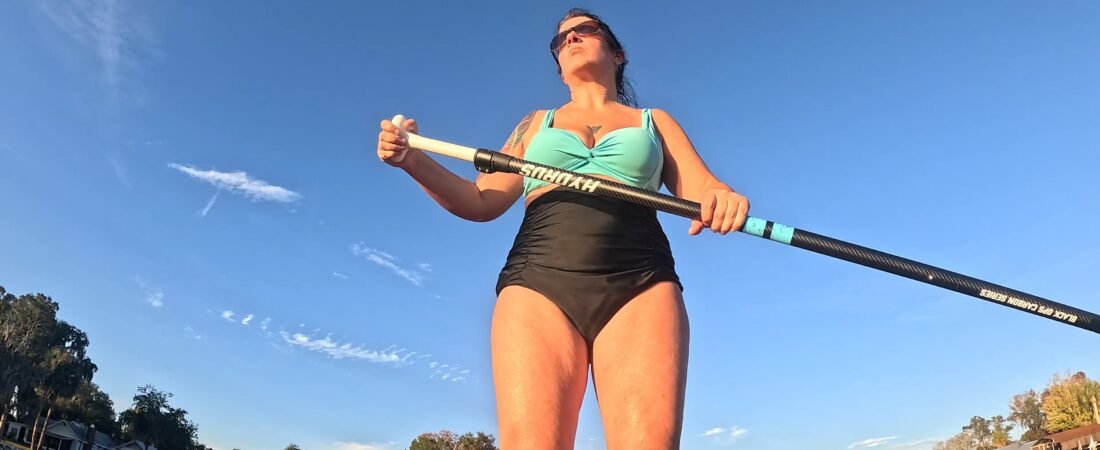
Life Doesn’t Come with a Stable Surface
Life rarely feels steady. Much like stepping onto a paddle board for the first time, it often feels like learning as you go, adjusting in real time, and hoping you don’t lose your balance along the way.
Even on days when the water looks calm, there is still wobbling. Tiny shifts under the board. Subtle movements you didn’t anticipate. Paddle boarding taught me quickly that stability is not something you arrive at and keep. It’s something you respond to moment by moment.
Life works the same way.
Balance is a Practice, Not a Destination
You never quite achieve “perfect” balance on a paddle board. Even when the water is glassy and still, your body is constantly making small adjustments to stay upright. The moment you lock your knees or tense up too much, you’re far more likely to fall.
I learned early on that staying rigid was the fastest way into the water.
Life asks for the same flexibility. Emotional balance is not about holding yourself to rigid rules or expecting constant calm. It comes from being responsive. From softening when things shift. From adjusting instead of bracing.
Stability doesn’t come from control. It comes from adaptation.
You Can’t Control the Water, Only Yourself
When you’re out on a paddleboard, you quickly realize how little control you actually have. You can’t stop the wind from picking up. You can’t change the current. You can’t smooth out the waves.
I’ve had days where the wind pushed me in the opposite direction of where I wanted to go, no matter how hard I paddled. Fighting it only made me more unsteady. What helped was widening my stance, slowing my breath, and working with the conditions instead of against them.
Life is no different. You can’t control circumstances or other people’s choices. You can only control how you respond. Letting go of the need to control everything creates far more steadiness than gripping tighter ever will.
Falling is Part of Learning
Everyone falls off the board eventually.
The first time I fell, I panicked. I felt disoriented and embarrassed and suddenly unsure of my ability to get back on. My heart was racing, and for a moment, I considered calling it a day.
Instead, I paused. Took a few deep breaths. Calmed my body. And then climbed back on.
That moment taught me something important. Falling didn’t mean I failed. It meant I was learning.
Growth requires discomfort. Mistakes are information, not verdicts. Confidence doesn’t come from staying upright all the time. It comes from knowing you can recover when you don’t.
Forward Motion Doesn’t Have to Be Fast
Paddle boarding is pretty slow. My average speed is usually around two or three miles per hour. It’s not impressive. It’s not a race.
But here’s the thing: moving slowly still moves me forward.
Going slower helps me stay balanced. It allows me to notice the water, the sky, the wildlife around me. Rushing usually leads to more wobbling and less enjoyment.
Life works the same way. Progress is not measured by speed. Slow growth is still growth. Pauses and rest are part of movement. Sometimes you move forward. Sometimes you drift back a bit. But all of it is motion.
Where You Look Matters
One of the first things I learned on a paddleboard is that looking down makes everything worse. Staring at your feet or the water beneath you almost guarantees instability.
Looking ahead at the horizon, with a soft focus, helps you stay upright.
In life, obsessing over fear, past mistakes, or every tiny misstep can destabilize us in the same way. Direction matters more than constant self-monitoring. Awareness without fixation keeps us grounded.
Some Days the Water is Calm. Some Days It Isn’t
On calm days, paddleboarding feels almost effortless. The board glides. Balance comes easily. Everything flows.
On windy or choppy days, it takes constant effort just to stay on course. But neither state lasts forever.
Life has calm seasons and turbulent ones too. Struggle doesn’t mean you’re doing something wrong. It means you’re human. Adaptation is resilience. Without challenge, we don’t build strength.
You Learn to Trust Yourself Over Time
I’m still relatively new to paddleboarding. In the beginning, I was scared often. Afraid of falling. Afraid I wouldn’t be able to get back on the board. Afraid of wildlife encounters (it is Florida, after all).
But through repetition, my confidence grew quietly. I learned how to shift my body with the board. How to respond to wind and current. How to recover when I drifted off course.
Some days, the wind still pushes me the wrong way. But now, I trust myself to correct course.
Life builds confidence the same way. Through experience. Through learning that you can handle more than you thought. Self-trust doesn’t arrive loudly. It grows through showing up again and again.
Sometimes You Paddle. Sometimes You Drift. Both Are Okay.
I don’t paddle the entire time I’m on the board. I paddle for a while, then find places where I can simply drift. Those moments of rest allow me to stay out longer.
Not every moment requires effort.
In life, constant striving often leads to burnout. Pauses are productive. Rest is not failure.
Staying on the Board is Enough
Paddle boarding isn’t about mastering the water. It’s about staying present and adaptable. About showing up even when things feel unsteady.
Life, like paddle boarding, isn’t about never wobbling. It’s about learning how to stay when the water moves beneath you.
And sometimes, staying is more than enough.
💌 Your Turn
What helps you stay steady when life feels unbalanced? I’d love to hear what keeps you upright when the water gets choppy.
Read more about how paddle boarding has changed my life in the posts Finding Myself on the Water and What Paddle Boarding Taught Me About Anxiety.
If you’re ready to take your own gentle first step, I’d love to invite you to subscribe to my newsletter. You will receive a free download of my 5-Day Self-Care Reset Plan. It’s a simple way to start making space for yourself again, in just five minutes a day.
Feel free to visit my Etsy shop for resources to help you on your journey. I also have a free private self-care interactive Facebook group for women that you can join here.
Follow me on socials:
Leave a Reply