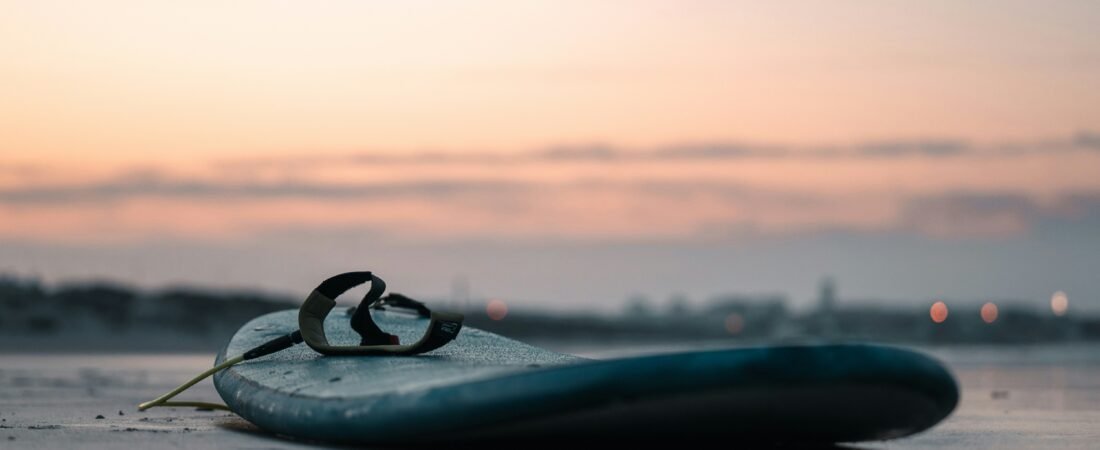
The first time I went paddle boarding, I was terrified to even try to stand up. I sat for the first half hour because I was convinced I would fall off the board immediately and maybe even get eaten by an alligator (it was fresh water in Florida after all). My brain immediately went into worst-case scenario mode: alligators, balance, embarrassment, you name it.
For the record, I did not fall in that day, and I’ve yet to meet a single alligator. So we’re doing okay.
Paddle boarding looks pretty calm from the outside, but staying balanced takes work, just like anxiety management. Learning how to stay steady on the water taught me how to keep my mind steady too.
Here’s what paddle boarding has taught me about staying afloat when my mind starts to wobble.
Balance Isn’t About Stillness: It’s About Micro-Adjustments
When you first get on a paddle board, your instinct is to stay as still as possible, like if you freeze hard enough you won’t fall off. Ironically, that is what makes you fall faster.
You are never truly still when you are standing on a paddle board. It requires a lot of subtle movements. Sometimes you have to move your feet, other times you have to lean your body a certain way. And of course, you are constantly paddling. It’s about constantly adjusting with little shifts, small movements, gentle corrections.
Much like paddle boarding, balance in life isn’t about eliminating anxious thoughts. It’s about adjusting as they come.
When I finally tried standing on the paddle board that first time, I realized that if I just went with the wobble a bit instead of trying to freeze, I could handle it. I stood up for the rest of the paddle and never fell off. The same is true for your mind. You just have to keep adjusting.
The More you Fight the Water, the Harder It Pushes Back
When you are on a paddle board and start to wobble, the instinct is usually to tense up and overcorrect, but that usually just makes it worse. The more I tried to control the board, the more it shook. It turns out, when you fight the water, the water fights back. When I finally loosened my grip, I found my rhythm.
The same is true for anxious thoughts. The more you try to resist them, the more amplified they become. If you just acknowledge the anxious thoughts without judging them or trying to escape, it can actually help the thoughts lose their power. You start to move with life instead of against it.
Falling Isn’t Failure: It’s Part of Learning
I have fallen off my board more than once. It was not pretty or graceful. Yes, there was splashing and yelling. And some muttered words that don’t belong in a PG-rated blog post. And I panicked and had a hard time getting back on my board. I was embarrassed too. The fall was unexpected when an underwater log snagged my board. I didn’t see it coming and had no idea what happened until I was in the water.
Falling off didn’t ruin the experience. It reminded me that I could get back up. I didn’t fail because I fell off the board. It is part of the learning process. You bet that I have since practiced getting back on my board though! Now I can do it with ease.
Anxiety makes us terrified of falling, of messing up, of losing control. But every time we fall and get back up, our brain learns something powerful: I can survive discomfort.
Falling in the water taught me what therapy had been saying for years: exposure builds resilience. You can’t learn balance without the occasional splash.
Focus on What’s Right in Front of You
If you look down at your feet while paddle boarding, you’ll almost always lose your balance. You have to look ahead to where you want to go.
The same goes for anxiety. When I focus on my fears, I spiral. When I focus on what’s right in front of me, the next small step, the next breath, I find my rhythm again.
It’s the simplest mindfulness lesson on earth: don’t stare at the wobble. Just keep paddling forward.
Calm Waters Don’t Mean No Currents
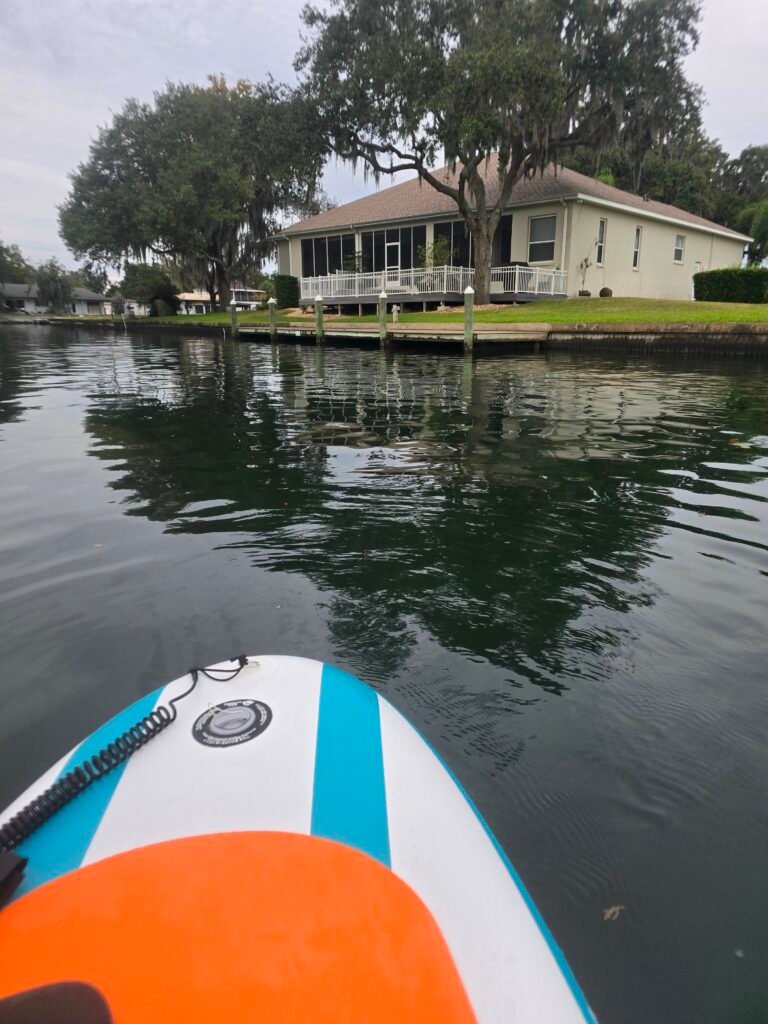
I usually paddle on a local spring. The water is generally calm. Even on perfectly still days, the water moves. You can’t always see it, but you can feel it beneath your feet.
That’s how anxiety works, too. Even in peaceful times, there’s still movement underneath: subtle waves of worry, what-ifs, or restlessness.
Learning to paddle taught me this: I don’t need the water (or my mind) to be perfectly calm to feel peace. I just need to know I can handle whatever comes.
The goal isn’t to eliminate the current. It’s to trust that you can float.
Your Environment Matters
Some days, the water is glassy and calm. Other days, the wind’s blowing, boats are passing, and I’m just trying not to drift into someone’s dock.
And you know what? Some days just aren’t paddle-boarding days.
That doesn’t make me weak. It makes me aware.
The same goes for anxiety. You can’t expect yourself to be calm and centered in chaotic, overstimulating environments all the time. Sometimes, you need calmer waters with less noise, fewer demands, more boundaries.
That’s not avoidance. It’s self-respect.
You Don’t Have to Paddle Alone
Some of my favorite days on the water have been with a friend, laughing, floating, exploring. Many days, I go alone, just me and the quiet.
Both kinds of days matter.
Anxiety can make you isolate or over-rely on others. Paddle boarding taught me balance there, too: connection when I need it, solitude when I crave it. Both are healing in their own ways.
Finding Stillness in Motion
Paddle boarding didn’t “fix” my anxiety. But it gave me something better: perspective.
It taught me that peace doesn’t come from eliminating the wobble, but from learning how to move with it.
It reminded me that falling isn’t failure. That small adjustments matter. That calm is something you create, not something you find.
And most importantly, it reminded me that healing doesn’t always happen on a couch or in a journal. Sometimes, it happens out on the water, one paddle stroke, one deep breath, one gentle wobble at a time.
💌 Your Turn
Have you ever found life lessons in an unexpected place, maybe on the water, on a trail, or in something you never thought would feel healing? I’d love to hear your story in the comments.
Here’s to staying afloat, riding the waves, and remembering: you don’t have to be perfectly steady to be strong.
If you’re ready to take your own gentle first step, I’d love to invite you to subscribe to my newsletter. You will receive a free download of my 5-Day Self-Care Reset Plan. It’s a simple way to start making space for yourself again, in just five minutes a day.
Feel free to visit my Etsy shop for resources to help you on your journey. I also have a free private self-care interactive Facebook group for women that you can join here.
Follow me on socials:
Leave a Reply